Digital dentistry
As digitalization progresses, we as dentists have the opportunity to digitize our patients.
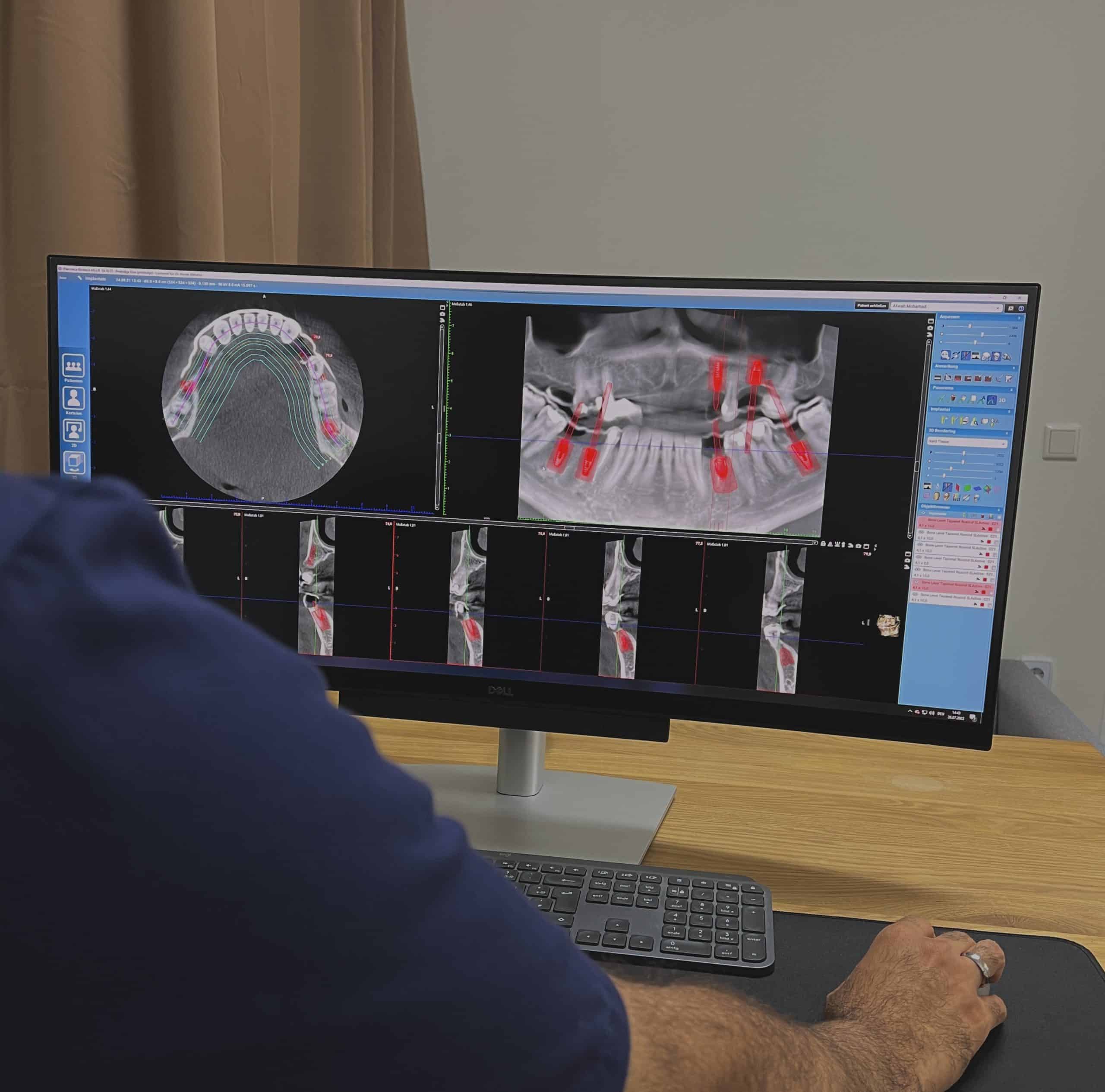
This digital image of the patient enables us to carry out treatments more precisely and accurately. For example, we can use computer-aided implantology to calculate exactly how an implant needs to be placed to achieve optimum function and aesthetics. The placement of the implant can also be perfectly positioned using navigated splints from the 3D printer, often even without cutting open the gums.
A major advantage of digital patient imaging is that we can simulate and check the treatment results before the actual treatment. This allows us to ensure that the planned treatment actually achieves the best possible results.
Overall, digital patient imaging enables us to provide even more precise and efficient treatment, which is beneficial for both the patient and the dentist.
We use various technologies for the digital patient.
- Digital 3D recording of the teeth with a special 3D scanner.
- Digital 3D X-ray image with a so-called DVT (dental volume tomograph)
- Software that uses artificial intelligence to collate the data and assist the dentist with treatment planning.
- Aesthetic planning software to plan the desired smile together with the patient.
- 3D production systems. Be it a 3D milling machine to produce dental prostheses down to a few micrometers or a 3D printer to produce computer-guided navigated drilling templates for implants, for example.
How does a 3D scan work?
With a 3D scan, the teeth are scanned using a special 3D camera. The 3D image is painless, takes just a few minutes and does not involve any radiation for the patient. The resulting colored 3D model is accurate to within a few micrometers with our high-tech camera from 3Shape and replaces the classic impression with silicone in almost all cases. The 3D file is then further processed in software.
3D planning
This 3D image is available to us directly on the computer for diagnostics and planning, allowing the treatment to be visualized virtually, which significantly improves visualization and fabrication. This means that the right material can be selected without any risks for the patient.
CAD/CAM
In dentistry, CAD/CAM is a technique in which dental prostheses are virtually designed on the computer and then immediately milled by a machine. This means that dentures can be produced within a very short time. The impression of the situation in the mouth is not made in the conventional way by taking an impression, but by scanning the teeth. The dentist can then design the dentures on the computer. Production is then carried out by a machine that mills the product from a prefabricated block or a special blank to an accuracy of a few micrometers.
So what is Cerec?
In the CAD/CAM process, the best restoration for the digitally photographed tooth is calculated on the computer screen and individually designed by the dentist. This procedure is also known elsewhere as the Cerec procedure.
In our practice, we only use high-quality, robust industrial milling machines, which work much more accurately than the conventional CEREC, which was built for dentists. The restoration (crown, inlay, bridge) is precisely milled out of ceramic using the 5-axis milling units. Thanks to the computer reconstruction and the high-quality machines, the restoration fits the tooth exactly. Manual errors caused by numerous intermediate human steps are eliminated as far as possible.

How is a 3D X-ray image created?
With the Promax 3D from Planmeca, we use one of the most modern and precise DVT (digital volume tomograph) available on the market. This makes us one of the few dental practices in Germany that can produce high-precision three-dimensional X-ray imageswith an accuracy of up to 75 µm, in which even individual root canals are visible.
The DVT image is required for complex root canal treatments or for the computer-assisted insertion of dental implants, for example. This technique makes treatment gentler, safer and more precise. The duration of the procedure can also be reduced.
The strength shows a 3D X-ray image in combination with the 3D scan. The images are superimposed so that an implant can be planned precisely in the bone. With the help of special software, this enables computer-navigated implantology, which saves patients from having to cut open their gums in many cases.
Other procedures that require three-dimensional positioning, such as the removal of wisdom teeth, apicoectomies and periodontal treatments (3D representation of bone fractures), can also be planned much more precisely and therefore with greater certainty. This considerably reduces the risk of injury to neighboring structures (e.g. nerves).
We are happy to produce DVT images for our colleagues.